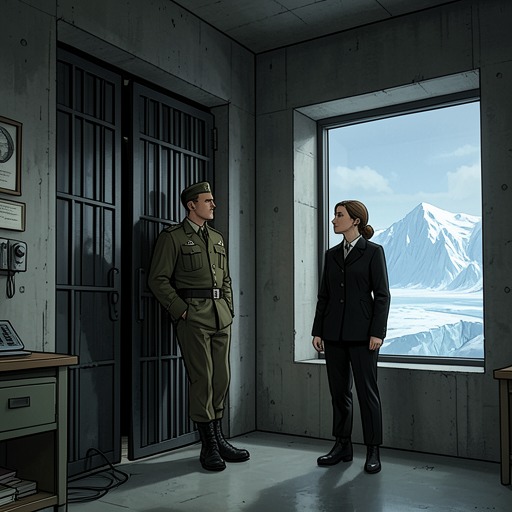
Count von Mantauffel
Operation NapoleonCount von Mantauffel is a German count among the passengers stranded after their aircraft crashes on Vatnajökull. Tougher and more determined than the others, he leaves the shelter of the plane to seek help, even as the survivors recognize how little chance he has of finding a way off the glacier. His departure makes him both a possible means of rescue and a troubling presence in the pilot’s account of the party’s final days.
Identity and Place in the Party
The Count belongs to a mixed party whose members have reached the glacier aboard a German aircraft. The surviving pilot’s diary presents him as a forceful figure: the toughest member of the group, and one desperate to get off the ice. He is not simply another passenger waiting for rescue. When the others remain with the wreck, he chooses to go out into the storm, accepting the danger of crossing the glacier rather than waiting for circumstances to change.
The pilot’s view of him is sharply divided. He recognizes the Count’s resolve, but describes him as a disturbing presence who continues to play the victor despite having lost the war. The Count’s bearing therefore carries a political shadow: even in a stranded party facing exposure and death, he seems to preserve the posture of a defeated regime’s authority. The diary does not explain what he says or does to create that impression beyond this judgment, so his characterization remains filtered through the pilot’s wary, increasingly desperate perspective.
Departure Across the Glacier
On the evening of Saturday 30 January, the party wraps the Count as warmly as it can and gives him two bars of chocolate. They believe that if he heads southeast he may find a route down from the ice, but neither the Count nor those left behind has much confidence in the plan. The pilot’s account makes the departure a practical gamble rather than a confident expedition: the Count is sent out because remaining inside offers no clear prospect of survival, not because the party knows he can reach help.
The decision also separates him from the survivors at a decisive moment. The pilot later records that the Count had no intention of dying there and that he was glad the Count had gone. The relief is not uncomplicated. The pilot says the Count’s presence had been disturbing, yet his departure removes one of the party’s strongest members from the plane. To the others, his absence carries the faint possibility that he might return with help, but the diary offers no confirmation that he reaches anyone.
The Stranded Survivors and the Diary
The Count’s departure is recalled in a diary written by the pilot, William Miller, and found by Ratoff beneath the co-pilot’s seat decades later. The entries are sporadic, pencilled, and not reliably separated by dates, as if the writer had lost track of time. Some are brief messages apparently intended for a future reader; at other points Miller addresses his brother, Colonel Miller. The uncertainty of the record matters to the Count’s story: his journey is described by someone trapped in the aircraft, not witnessed from outside, and its duration and outcome remain unknown.
Miller’s entries place the departure against a worsening emergency. The storm makes it impossible to stand outside, attempts to force the door open fail, and the plane becomes a metal enclosure in which the survivors are slowly dying. The group has little food, the air grows stale, and the kerosene lamps are running low. One entry says that a man named Dietrich died in agony and was put outside on the ice; Miller also notes the snow blowing into the aircraft and the lack of any likely rescue. In this setting, the Count’s journey is neither a secure escape nor a simple act of leadership. It is a desperate attempt to act when the remaining options appear to be waiting, freezing, or dying inside the wreck.
Disappearance and the Wreck’s Remains
When Ratoff later examines the aircraft, he finds a German officer’s body beside the fuselage, dressed in uniform and wearing an Iron Cross. The body appears to have been deliberately laid there, and one leg is missing. The discovery echoes Miller’s account of a party in which people who survived the crash moved and tended to those who died, but the officer is not explicitly identified as Count von Mantauffel. Ratoff’s subsequent inspection finds further bodies inside the aircraft, including another German officer, and establishes that the wreck contains six corpses although his briefing had led him to expect seven.
The Count’s last recorded action thus remains suspended between two possibilities: a perilous attempt to reach help and an absence that the later recovery cannot conclusively explain. A separate diary passage says he took a metal box handcuffed to his wrist when he left, suggesting that he carried an object of importance into the storm; the account does not establish what became of it. His disappearance links the wreck’s physical evidence to the party’s unresolved history, while the contrast between his confidence that he would not die there and the survivors’ growing certainty of their own deaths gives his departure its bleak force.